

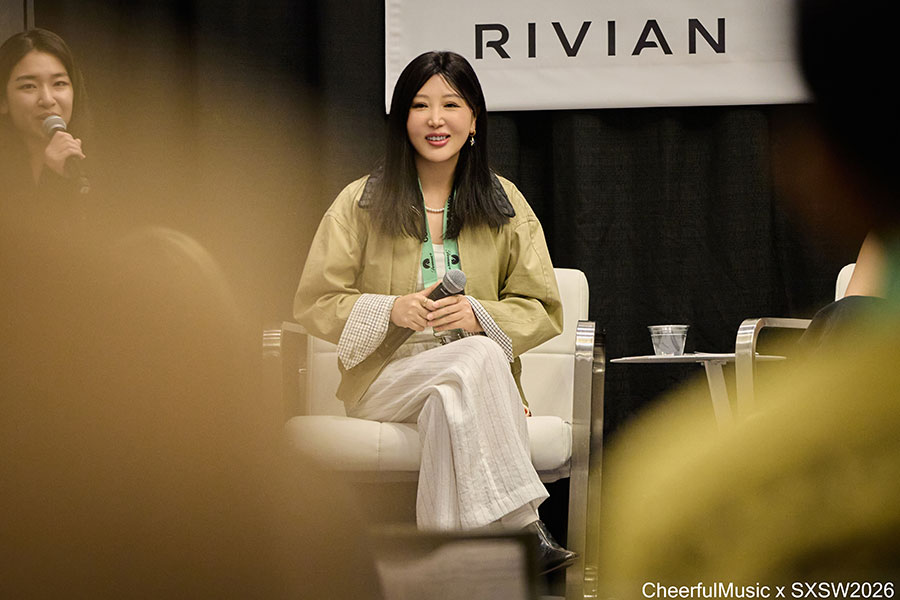
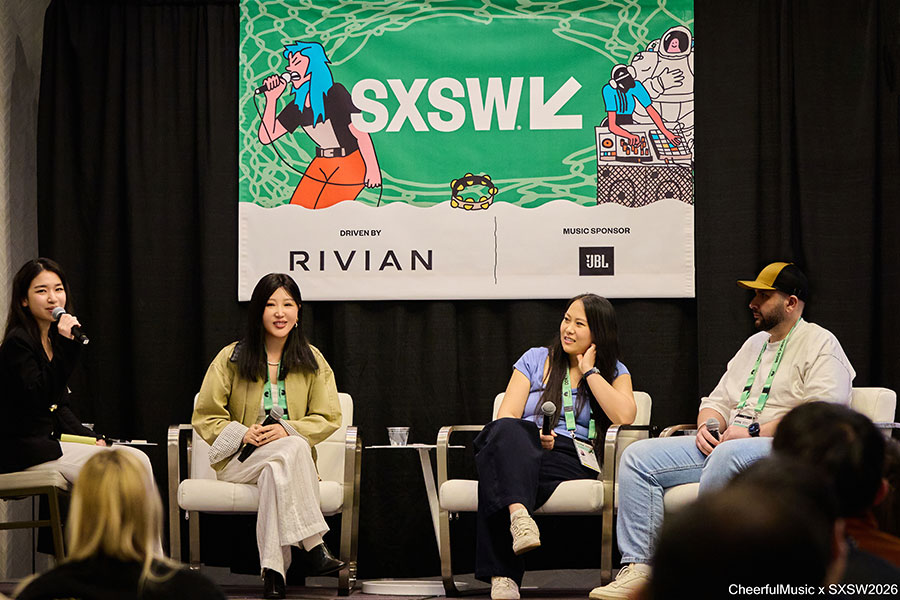
At SXSW 2026, the “East x West: Cross-Cultural AI Trends in Music Production” panel didn’t just explore artificial intelligence in music, it reframed the conversation through the lens of those actively shaping its future. Spearheaded by Snow Jiang, Founder of Cheerful Music, the session brought together three essential perspectives within the modern music ecosystem: the label, the platform, and the creator.
Millennial Magazine was in the room, capturing firsthand how China’s rapidly evolving digital music market is emerging as a critical testing ground for AI adoption.
Alongside Snow Jiang were Vivian Wei, Vice President of Copyrights at NetEase Cloud Music, and international producer MKJ. Each represented a distinct force influencing how music is made, distributed, and experienced today.
What created a particularly compelling discussion was the dynamic between these roles. Vivian Wei offered a platform-level view of how AI-generated music is rapidly entering China’s streaming ecosystem. MKJ grounded the conversation in the realities of artistry, speaking candidly about creativity, identity, and the risks of over-reliance on technology. And at the center of it all, Snow Jiang articulated a clear and intentional philosophy from a label, one that neither resists AI nor blindly embraces it, but instead positions it as a tool in service of human expression.
That philosophy is deceptively simple: AI should enhance creativity, not replace it. Rather than pursuing fully automated production, Cheerful Music prioritizes original composition, cultural depth, and artist identity, using AI selectively to expand possibilities without compromising authenticity. Snow Jiang emphasized that this approach is not about rejecting innovation, but about preserving what makes music meaningful in the first place.
In a global music economy increasingly defined by scale and speed, this approach reframes value around something far more scarce: emotional resonance.
This is precisely why Cheerful Music’s role in leading this panel matters. As China becomes one of the most active grounds for AI in music, the conversation is no longer about whether AI will transform the industry, but how to ensure that transformation doesn’t come at the cost of what makes music human.
China’s AI Music Boom: Where Scale Is Already Reality
If there was a defining moment in the panel, it came when Vivian Wei spoke to how deeply AI has already penetrated China’s music infrastructure. NetEase is often compared to platforms like Spotify, and as Vivian Wei explained, AI-generated content is now a visible and growing part of the overall music ecosystem.
That’s not a projection. That’s the present.
With millions of AI-generated or AI-assisted tracks circulating across major platforms, China is operating at a scale that the Western market has yet to fully confront. While platforms like Spotify are still experimenting with moderation and removal, Chinese platforms are already managing the realities of high-volume AI content in real time.
But perhaps the most revealing insight isn’t the volume, but the lack of impact.
Despite this overwhelming influx, listener behavior has remained remarkably stable. Mainstream consumption in China continues to center around familiar genres such as Mandopop and R&B, with emotionally driven songs maintaining dominance across streaming platforms.
In other words, even as production becomes limitless, taste remains deeply human.
Why China’s AI Music Market Looks Nothing Like the West
The contrast between China and Western markets isn’t just about scale. It’s about mindset.
In the West, AI music is still largely framed as a disruption. In China, it’s already integrated into the system, forcing stakeholders to adapt in real time.
China’s platforms are dealing with massive daily upload volumes, regulatory scrutiny around content and copyright, and a surge of non-traditional creators entering the music industry.
Meanwhile, Western platforms are still grappling with foundational questions: what counts as authorship? What should be removed? What is fair compensation?
Vivian Wei captured this tension succinctly, “When it comes to royalty sharing, it’s a gray area now everywhere.”
But China isn’t waiting for perfect answers. It’s building frameworks while the system is already in motion.
The Power of Cultural Identity
Amid this technological acceleration, Cheerful Music’s approach offers a compelling counterbalance.
Rather than chasing automation, the label has chosen to double down on cultural authenticity.
Snow Jiang explained, “At Cheerful Music, we don’t do one-click generation of music. We focus on what we do best, which is the traditional Chinese style music. We are still preserving traditional instruments and continuing songwriting camps while exploring AI in a balanced way.” The label continues to incorporate opera-inspired elements, and cross-cultural collaborations into its productions, ensuring that innovation does not erase identity.
This commitment extends beyond sound into philosophy. While AI is used as a supporting tool at Cheerful Music, Snow Jiang emphasized, “it does not replace creativity.”
In a market flooded with algorithmic output, the music label is positioning itself around something far more difficult to replicate: identity.
Artists in the AI Era: Identity Over Efficiency
For artist MKJ, the rise of AI doesn’t signal the end of musicianship. Instead, it signals a shift in what matters. “I don’t think it will ever replace human artists because strong identity will always come on top,” he said.
That idea of “identity as currency” resonated across the panel.
AI can generate infinite variations of sound, but it cannot replicate lived experience. And in an environment where millions of tracks compete for attention, individuality becomes the ultimate filter.
Still, the disruption is real. Snow Jiang acknowledged that in China, AI has already replaced certain types of creators, particularly those producing formulaic work.
What remains are the artists who cannot be templated.
The Creative Tradeoff: When AI Makes Artists Faster and Lazier
One of the panel’s most candid moments came when MKJ addressed the unintended consequences of AI adoption, “I think it does make artists lazy… If you keep using it, you depend on it too much.”
This tension, between efficiency and erosion, is central to the current moment.
AI can accelerate workflows, generate ideas, and streamline production. But without discipline, it can also dilute the creative process.
That’s why the philosophy behind Cheerful Music feels particularly relevant. It doesn’t reject AI, it contextualizes it.
Snow Jiang reinforced that balance is key, noting that technology should enhance artistic expression while preserving originality and cultural meaning. “The faster AI develops, the more valuable human-created music becomes.”
Technology is a tool. Creativity is the source.
Branding in China’s Music Ecosystem: The Real Barrier to Entry
If AI has lowered the barrier to making music, it has simultaneously raised the bar for becoming an artist.
Vivian Wei highlighted that artists today must build a strong personal brand, noting that AI alone cannot create audience connection.
This is where many AI-generated creators fall short. They can produce content, but they cannot build narrative, identity, or emotional connection.
And in China’s hyper-competitive digital ecosystem, those elements are non-negotiable.
Even independent artists, while growing in overall market share, face increasing difficulty breaking through individually. The issue isn’t AI alone. It’s saturation.
Marketing in an Oversaturated Market: Creativity Still Wins
With tens of thousands of songs uploaded across platforms each day, visibility has become one of the industry’s most complex challenges. But more content isn’t the answer.
Snow Jiang confirmed this reality from a label perspective, “There are tens of thousands of songs on the internet every day. It’s very exaggerated. At Cheerful Music, we do a lot of marketing. Of course, we still go back to promoting our original music.”
Vivian Wei added, “It’s really not about how many posts… it is still about the creative mind behind the campaign.” This insight underscores a critical shift: marketing is no longer about scale. It is now about the concept.
Snow Jiang emphasized that Cheerful Music continues to prioritize how music connects with audiences rather than simply increasing output.
Whether it’s AI-generated visuals, unexpected cultural mashups, or narrative-driven campaigns, what cuts through is originality.
And once again, this is where Cheerful Music’s emphasis on storytelling and cultural fusion positions it ahead of the curve.
Copyright and Compensation: Defining Value in a Hybrid World
As AI blurs the line between creation and automation, the question of ownership becomes increasingly complex. Vivian Wei proposed a model that reflects a growing industry consensus: compensation should be tied to human contribution.
“If you just spend five seconds [creating a song]… then it’s definitely not as much input [as a human],” she said, advocating for tiered royalty systems.
MKJ reinforced this perspective from the artist’s side, “I don’t think a prompt can get creative.”
Snow Jiang followed, “As a label, we also think there should be a distinction between AI-generated music and music assisted by AI…the more AI progresses, the more we will challenge human artists.”
The new obstacle lies in measurement. How do you quantify creativity in a hybrid process? How do you distinguish between assistance and authorship?
These are questions the industry has yet to fully answer, but China is actively attempting to do so.
Emotion as the Last Scarce Resource
As the discussion turned toward the future, one theme emerged with clarity: AI may transform production, but it cannot replicate emotional connection.
“Music is something that connects us emotionally… we will always be attracted to connect,” Vivian Wei said.
This is where the limits of AI become most apparent.
It can simulate style, structure, even voice, but it cannot simulate experience. And without experience, it cannot create meaning in the way human artists do.
Why Cheerful Music Represents the Future of a Human-Centered Industry
What the EASTxWEST panel ultimately revealed is not a battle between humans and machines, but a recalibration of value. China has proven to already be navigating this at scale.
As AI continues to flood platforms with content, the industry is being forced to redefine what matters:
- Resonance over volume
- Identity over efficiency
- Intention over automation
And in that landscape, Cheerful Music stands as a model for what endures. When music becomes effortless to produce, the only thing that remains rare is something that feels real.