

Corn. Soy. Cotton. These are the crops covering the bulk of America’s farm land. When science crosses with farming, biotechnology splits the genes of plants or animals, and produces man-made alterations known as genetically modified organisms (GMOs). These GMOs are controlled by one entity…Monsanto. Although the farm industry is essentially owned by five companies: Monsanto, DuPont, Syngenta, Bayer, and Dow, Monsanto licenses GMOs directly to their competitors. Think Progress reports that “93 percent of soybeans, 88 percent of cotton, and 86 percent of corn in the US are grown from Monsanto’s patented seeds.”
 On March 26, 2013, President Obama signed the Budget Control Act of 2011, the sequestration bill, which reduced federal spending by $85 billion. The press followed this political fiasco closely and reported that important positions, like law enforcement and meat inspection agencies, were going to be cut back. But what the press neglected to inform the public about was bill H.R. 933- the Continuing Appropriations Act of 2013 which was secretly added into the Budget Control Act. This provision included a biotech rider buried within Section 735 which exempts genetically modifying companies like Monsanto from court orders that stop the manufacturing and distribution of such engineered seeds. It states that upon request, the Secretary of Agriculture can immediately grant temporary permits and deregulations to farmers, growers, operators, and/or producers. This further “authorizes the movement, introduction, continued cultivation, and commercialization” of deregulated crops such as GMOs. These redesigns by Monsanto are sold to farmers on the idea of increasing crop yields and preventing the need for herbicides. The Biotechnology Industry Organization (BIO) states on their website that GMOs allow farmers to generate “higher crop yields with fewer inputs.” However, researchers at the University of Wisconsin conducted a study on the use of GMOs in the United States and found evidence of “yield drag.”
Modified genes interact in a way which causes the crop to be less productive and consequently have negative effects on the yield. According to Mother Jones the University of Wisconsin report suggests that “manipulating the genome of a plant variety causes unintended changes in the way it grows, causing it to be less productive.” Monsanto’s product SmartStax is a multiple added gene, stacked with traits which contain both herbicide-tolerant and pesticide-expressing genes. It is sold on the basis that the product strengthens the plant to defend against herbicides and fight off toxic bugs with its Bacillus thuringiensis (Bt), a soil bacteria that delivers anthrax to certain insect species.
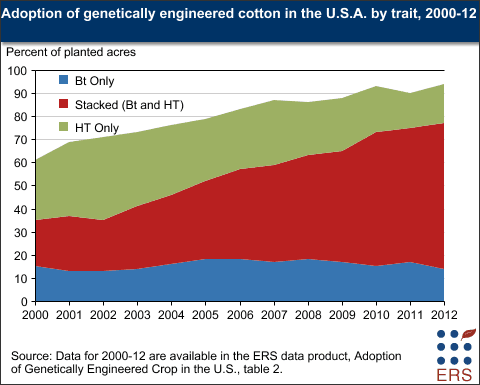
Washington State University researcher, Charles Benbrook, has also found that while the defense against bugs has reduced the level of insecticide farmers spray on plants, the crops have become resistant to regular doses of Monsanto’s Roundup Ready herbicide technology due to the mutation of the plant which has developed “superweeds” and “superworms.” This has cause farmers to purchase more of the biotech giant’s product resulting in a 37 percent increase in sales for Monsanto since they hit the market and introduced GMOs in the 1990s. The USDA has shown that since GMOs have consumed the farming industry, the average cost to plant one acre of soybean seeds have dramatically risen 325 percent, from $13.32 to $56.58. Soybeans are not the only crops to have been affected. From 1995-2011 “cotton seeds spiked 516 percent…and corn seed rose 259 percent.”
Farmers have been feeling the brunt of Monsanto’s monopoly as well, as the biotech firm devotes “$10 million a year and 75 staffers to investigate farmers for possible patent violations.” Over the last 13 years, this has resulted in lawsuits with over “410 farmers and 56 small farm businesses” regarding patented seed production laws. Traditionally, seeds from the first harvest are turned over into a second and so forth, but the chances of having second generation seeds are significantly reduced with genetically modified seeds. This gives Monsanto the ability to claim ownership of their seeds from purchase, and sue any farmer who uses their seeds for a second harvest without reinvesting for the production. Think Progress also points out that seeds are often “carried by birds or blown by the wind into fields of non-GM seeds, exposing farmers who have never bought seeds from Monsanto to lawsuits.” Going against nature is not only hurting the small farmer, but is also clogging out judicial system and poisoning our food.
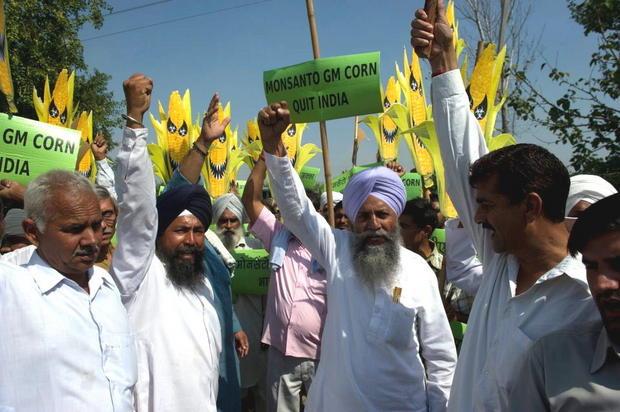 Last June [2012], 5 million Indian farmers sued Monsanto for $7 billion, and accused the company of “groundbreaking biopiracy charges” in an effort to stop the “patent on life.” Selling their seeds on the notion that their yields could end world hunger, Indian farmers bought the GMOs with their life savings. But unfortunately, the GMOs did not take to the land as intended and grew resistant to pesticides. This forced farmers to buy more seeds and apply heavier doses of pesticides with the hope of restoring their farms and providing their families and businesses with a healthy harvest. However, in the last decade, over 250,000 Indian farmers have committed suicide due to the exorbitant debts that weren’t covered by their expected crop return.
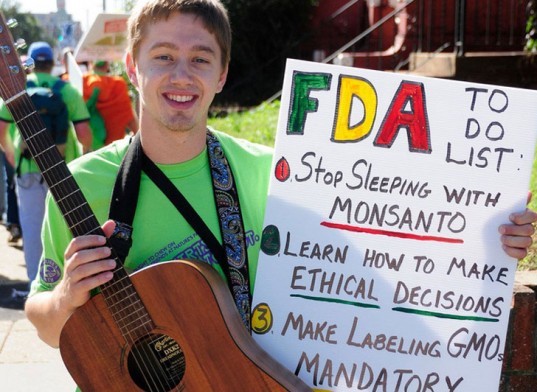 To further complicate the problem, Think Progress reports that Monsanto has placed former employees in the Department of Agriculture, Food and Drug Administration (FDA), and Environmental Protection Agency (EPA) over the last few decades. In addition, a new food and water watch report states, “Monsanto’s board members have worked for the EPA, advised the USDA, and served on President Obama’s Advisory Committee for Trade Policy and Negotiations.” The dominance of government positions overseeing the farming industry begs a closer look at how they are able to push pro-GMO agendas “within the government and influence public opinion.” As a result, the USDA has never rejected an application from Monsanto regarding the production and distribution of genetically engineered crops. Monsanto sells themselves as a sustainable agricultural company, but with crops that don’t produce a high yield or return for multiple seasons, the only sustainable aspect of Monsanto is their presence within the industry.