

There is a specific kind of tired that a normal weekend does not fix.
You sleep later on Saturday. You finally deal with the errands that have been accumulating since Tuesday. You order something good for dinner, spend a little too much time on your phone, and promise yourself Sunday will be slower. Then Sunday night arrives and the fatigue is still there, sitting somewhere between your shoulders and your inbox.
The problem may not be that you failed to rest. It may be that you never actually left the environment asking things of you.
That is the appeal of restorative weekend getaways in the US: not a miniature vacation crammed with reservations, sightseeing, and photographic evidence, but a short, intentional change of scenery designed around doing considerably less.
And less, when done properly, can feel luxurious.
You do not necessarily need a passport, PTO request, or elaborate itinerary. What you need is somewhere close enough to reach without exhausting yourself and different enough that your usual rhythms are interrupted.
Across the country, some of the most compelling places for that kind of escape have been drawing travelers for generations, often because of what the landscape itself provides: mineral springs, forests, lakes, mountains, open skies, and enough quiet to hear yourself think.
For city dwellers who have mastered productivity but become less fluent in stopping, these seven destinations make a persuasive case for keeping the next escape closer to home.
Why the Best Weekend Getaways in the US Might Be Closer Than You Think
When we are genuinely depleted, distance can start to look like the solution. We fantasize about somewhere very far away, preferably requiring linen clothing and an international terminal.
But long-distance travel comes with its own expenditure of energy: airport transfers, security lines, delays, time changes, packing decisions, and the strangely taxing logistics of getting somewhere supposedly relaxing.
A relaxing weekend trip works differently. Proximity is not the consolation prize. It is the strategy.
A destination within a few hours of home makes rest easier to repeat instead of turning it into an annual event you spend six months planning. The objective is not to accumulate destinations. It is to create enough distance from your ordinary environment that your pace can change.
Here are seven places that understand the assignment.
1. Hudson Valley, New York: For the New Yorker Who Needs to Disappear Into the Trees
Best for: Historic grandeur, hiking, lake views, spa time
From: New York City
Restorative anchor: Nature without sacrificing comfort
The Hudson Valley hardly qualifies as an insider secret anymore, but popularity does not diminish its particular usefulness to exhausted New Yorkers.
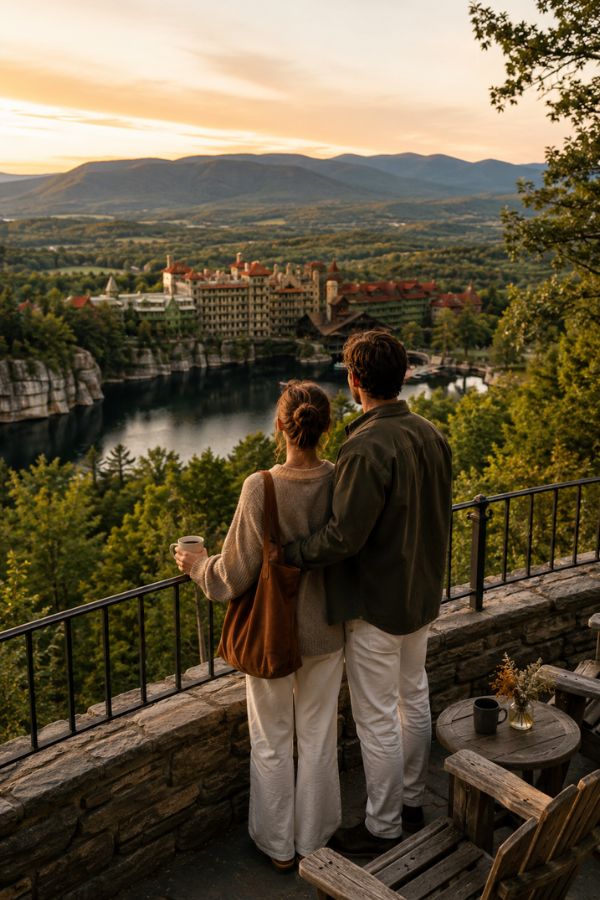
Its advantage is range. You can build a weekend around art and restaurants, retreat to a design-conscious cabin, or go fully old-world at Mohonk Mountain House in New Paltz.
Mohonk has been owned and operated by the Smiley family since Albert Smiley purchased land and a small inn beside Lake Mohonk in 1869. The property later became a National Historic Landmark, and its original philosophy incorporated recreation and the renewal of body, mind, and spirit.
That history matters because Mohonk illustrates something the contemporary wellness industry occasionally forgets: restorative travel existed long before wellness became an aesthetic.
Here, the setting does much of the work. There are trails and carriage roads, gardens, water, sprawling lawns, and the theatrical silhouette of the Victorian resort itself. You can hike until your mind gets quiet, sit beside the lake, book spa time, or simply enjoy the increasingly radical experience of not having somewhere else to be. The best part, it’s an all-inclusive resort, should you choose to stay! Every meal, activity, and amenity is included in the price of the room (note, the 3-night minimum).
The broader Hudson Valley makes this one of the best wellness weekend getaways in the US too. The region does not require committing to the grand-resort version of restoration. The real luxury is access to landscape and a temporary exit from New York’s velocity.
Try This: Choose one outdoor ritual for the weekend, whether it is a morning hike, lake walk, or hour spent reading outside. Build everything else around it rather than filling the calendar.
2. The Berkshires, Massachusetts: For the Bostonian Who Wants Someone Else to Set the Pace
Best for: Yoga, structured retreats, spa programs, wooded seclusion
From: Boston
Restorative anchor: Letting a retreat environment make the decisions
Western Massachusetts has long understood the relationship between landscape and retreat.
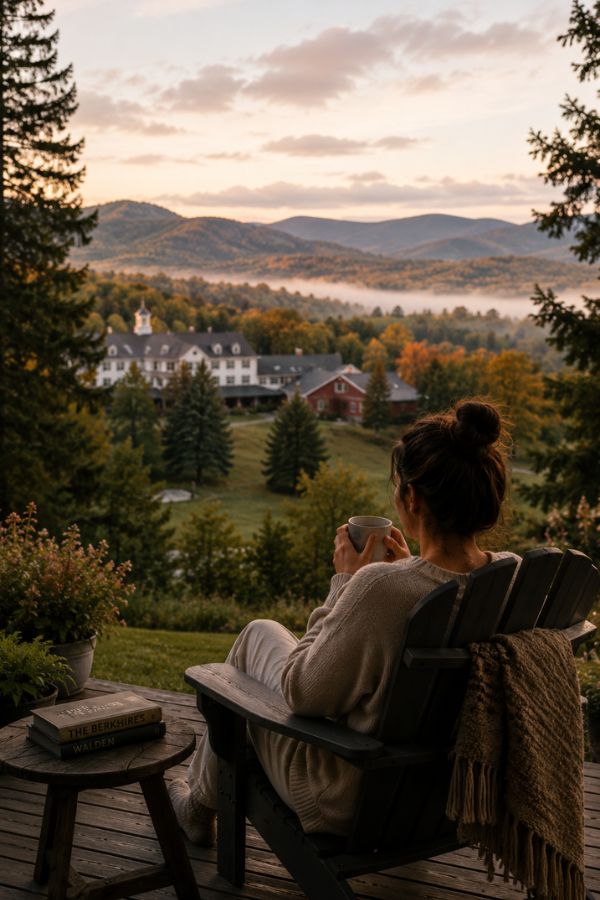
The Berkshires combine cultural sophistication with something increasingly difficult to manufacture: actual breathing room. For a reset with more structure, Kripalu Center for Yoga & Health in Stockbridge is one of the region’s defining destinations.
Kripalu describes itself as North America’s largest yoga retreat center. Its campus occupies more than 100 acres in the Berkshires, close to Lenox and Stockbridge, with programming centered on yoga, mindfulness, healing arts, reflection, and renewal.
What makes this style of escape useful is precisely what makes it different from checking into a conventional hotel. You are not merely changing rooms. You are changing rhythms.
Meals, movement, nature, and periods of deliberate quiet give the weekend a framework without requiring you to micromanage it. Sometimes the most restorative thing money can buy is temporarily having fewer decisions to make.
Try This: If you spend your week managing people, clients, content, children, or an endless calendar, choose a retreat where part of the rhythm is already established. Your task is not to optimize the schedule. It is to participate in it.
3. Ojai, California: For the Angeleno Who Needs the Volume Turned Down
Best for: Golden-hour walks, spas, food, unhurried afternoons
From: Los Angeles
Restorative anchor: A slower valley rhythm
Los Angeles has an extraordinary ability to make 12 miles feel like an expedition, which makes escaping its gravitational pull especially satisfying.
Enter Ojai.
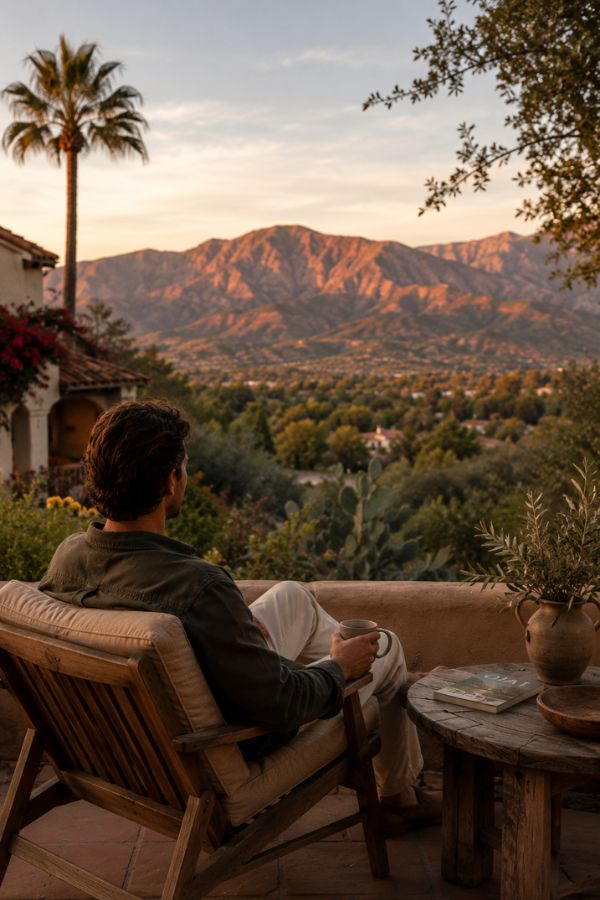
Tucked into a valley northwest of Los Angeles, Ojai has developed an almost mythic reputation among Southern Californians seeking a quieter frequency. Part of that reputation belongs to the landscape itself, particularly the celebrated “Pink Moment,” when sunset light illuminates the Topatopa Mountains in shades of pink and rose. The phenomenon has become part of the valley’s identity.
Ojai Valley Inn occupies the luxury end of the spectrum, but Ojai’s real appeal extends beyond any single hotel. It is found in the scale of the town, its agricultural surroundings, long lunches, independent businesses, wellness culture, and the simple pleasure of watching daylight change across the mountains.
This is not a destination demanding conquest.
That is exactly why it works.
For Angelenos accustomed to navigating traffic, social calendars, launches, shoots, meetings, and an industry culture that can turn even leisure into networking, Ojai offers another proposition: arrive, eat something good, walk somewhere beautiful, and watch the sun go down.
Try This: Do not make dinner the main event. Make sunset the reservation. Arrange the evening around being outside when the mountains change color, then allow the rest of the night to remain gloriously underplanned.
4. Calistoga, California: For San Franciscans Who Prefer Their Reset Geothermal
Best for: Mineral pools, mud baths, wine country without the rush
From: San Francisco
Restorative anchor: Getting into the water
Napa Valley may be internationally synonymous with wine, but at its northern end, Calistoga has another element bubbling beneath the surface. Literally.
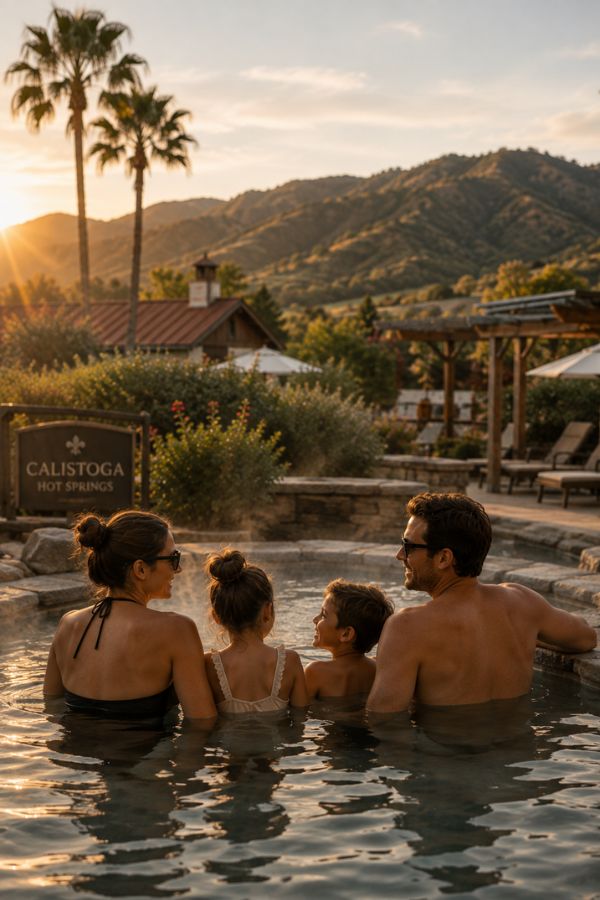
The town’s identity has long been connected to its geothermal activity, mineral springs, and mud baths. That makes Calistoga particularly compelling for travelers interested in the restorative side of Napa rather than a weekend organized around tasting-room appointments.
There is something satisfyingly uncomplicated about making water the centerpiece of restorative weekend getaways in the US. Soak. Get out. Eat. Read. Get back in.
The brilliance is in the repetition.
A mineral-pool weekend also eliminates one of the central problems of contemporary leisure: the compulsion to maximize every available hour. Once you decide that soaking is the point, the pressure to manufacture an itinerary begins to disappear.
Wine country can still be part of the experience, naturally. But Calistoga allows Napa to become background rather than assignment.
Try This: Book fewer tasting appointments than you think you should. Give the mineral pools the largest block of unscheduled time. A trip does not become more valuable because every hour has been monetized by an activity.
5. Olympic Peninsula, Washington: For Seattleites Who Need the Rainforest to Take Over
Best for: Forest immersion, hot springs, hiking, digital disconnection
From: Seattle
Restorative anchor: Nature big enough to interrupt your thoughts
There are relaxing landscapes, and then there are landscapes so atmospheric that they seem to alter the speed of time.
Washington’s Olympic Peninsula belongs to the latter category.
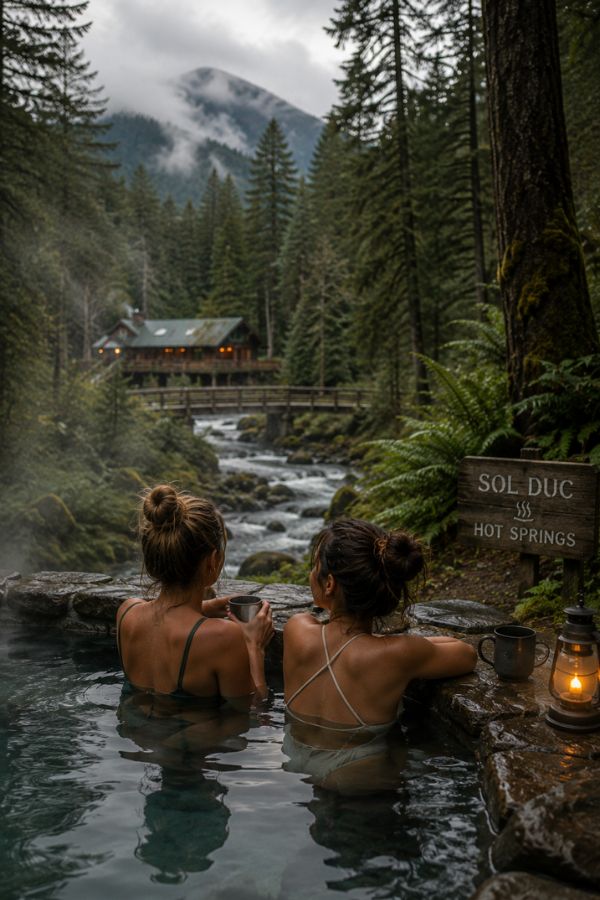
Inside Olympic National Park, Sol Duc Hot Springs brings geothermal soaking into the dense, mossy environment of the peninsula. The National Park Service documents a long history around the area’s hot springs, including a resort built in the early 20th century.
But the reason to come is not really historical.
It is sensory.
Mist. Water. Cedar. Ferns. Rain. Trails disappearing beneath a canopy that makes your notifications feel almost comically irrelevant.
For travelers who find conventional spas too polished or urban wellness experiences insufficiently removed from everyday life, the Olympic Peninsula offers the opposite: immersion in a landscape that refuses to revolve around you.
That perspective can be surprisingly restorative.
You do not need to improve the rainforest. You do not need to create content about the rainforest. You do not even need to understand the rainforest.
You can simply walk through it.
Try This: Put the phone away before entering the trail rather than waiting until you lose service. Notice how different the experience feels when you are not constantly deciding whether something deserves to become a photograph.
6. Lake Geneva, Galena, or Harbor Country: For Chicagoans Who Need Water, Quiet, and a Smaller Horizon
Best for: Lake views, historic towns, low-pressure weekends
From: Chicago
Restorative anchor: Trading city scale for small-town scale
Chicago does not have quick access to hot-spring valleys or coastal mountains, but it has something equally effective: water and a collection of small destinations where the scale of daily life shrinks considerably.
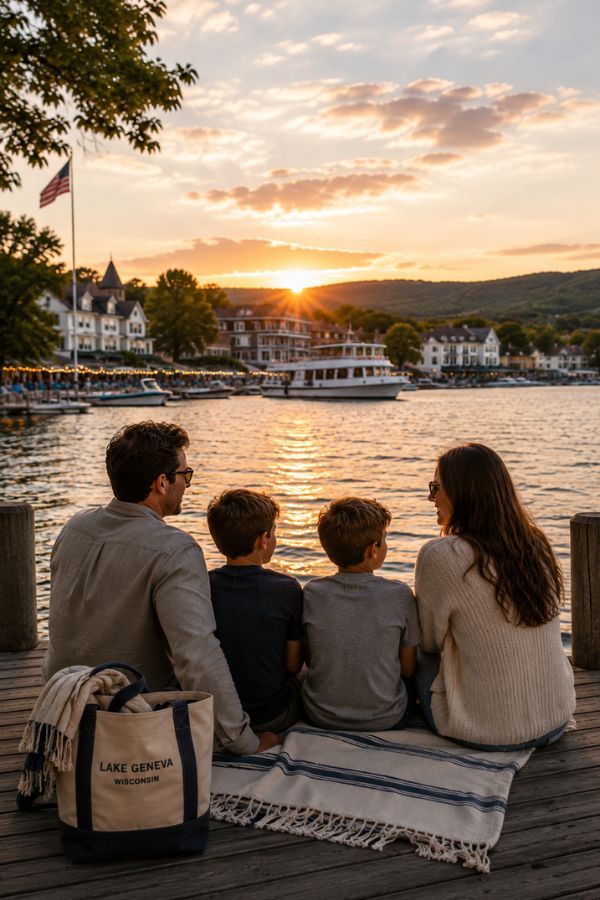
Lake Geneva in Wisconsin offers the classic lake escape. Galena in northwest Illinois brings historic architecture, rolling terrain, and small-town pacing. Across the lake in southwest Michigan, the communities of Harbor Country offer beaches, restaurants, inns, and the particular emotional reset that comes from staring at a body of water considerably larger than your inbox.
The smartest choice depends less on which town is objectively “best” and more on what you need.
Want to walk beside water? Lake Geneva.
Want historic atmosphere and leisurely wandering? Galena.
Want beach-town energy without boarding a plane? Look toward southwest Michigan.
The essential ingredient is not a marquee wellness property. It is contrast.
A quiet weekend escape becomes restorative when it removes enough of your normal stimuli that you stop operating exactly as you do at home.
Try This: Choose your destination according to the environment you crave, not the restaurant you saw on social media. Water, woods, historic streets, or complete seclusion? Start there.
7. Texas Hill Country: For Austinites Who Need a Bigger Sky
Best for: Swimming holes, small towns, stargazing, long drives
From: Austin and Central Texas
Restorative anchor: Water by day, stars by night
When urban life starts to feel compressed, there is something psychologically useful about going somewhere with a much larger horizon.
Texas Hill Country delivers it beautifully.
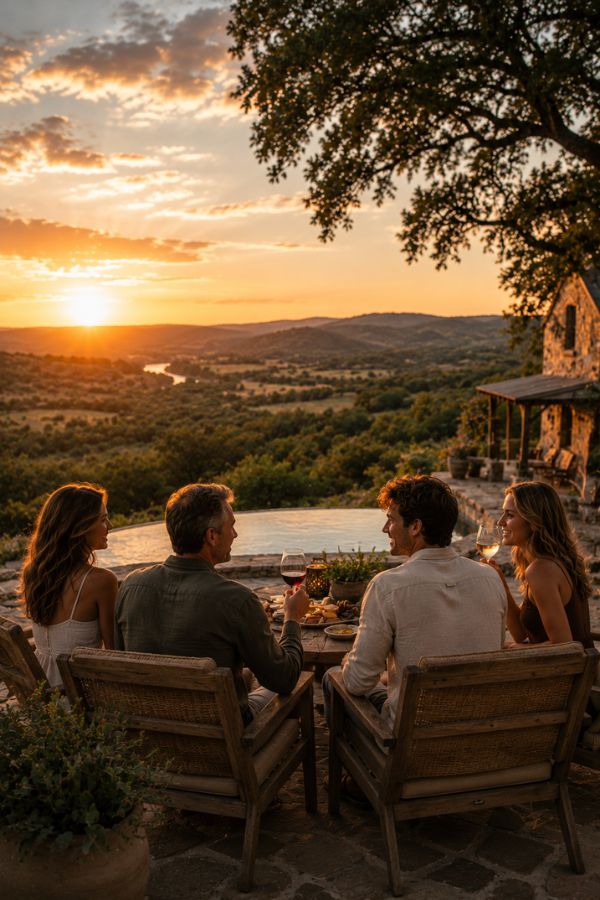
Wimberley offers access to the landscape and swimming-hole culture associated with the region, while Fredericksburg provides a more developed weekend base surrounded by Hill Country scenery. Head farther from major population centers and another restorative asset becomes obvious after sunset: darkness.
The shift is elemental. Swim. Wander. Eat. Sit outside after dark.
For travelers whose ordinary evenings are illuminated by laptops, televisions, phones, streetlights, and the ambient glow of the city, simply spending an hour beneath a genuinely dark sky can feel startlingly unfamiliar.
That is the kind of unfamiliarity worth seeking.
Try This: Give yourself one night without an entertainment plan. Sit outside after dark instead. The absence of an agenda is not empty time. It is the point.
The Catch: You Can Bring Your Stress Anywhere
There is one flaw in the fantasy of the restorative escape.
You are going too.
A beautiful hotel cannot stop you from answering Slack beside the pool. A mineral spring cannot prevent you from checking email between treatments. You can drive three hours into the countryside and reproduce your entire workday from a considerably prettier chair.
Geography is a tool, not a cure.
Changing environments removes some of the cues associated with ordinary obligations: laundry, errands, familiar rooms, the desk where work keeps happening long after work supposedly ended. What it cannot do is make the decision to disconnect for you.
There is another trap, particularly for a generation fluent in optimizing experiences: turning rest into another performance.
Find the perfect hotel. Order the photogenic breakfast. Book every treatment. Document the sunset. Research the “must-do” coffee shop. Return home requiring recovery from the weekend designed to restore you.
A successful restorative weekend getaway should contain less.
Less scheduling. Less checking. Less proving. Less pressure to make the experience productive.
What These Trips Are Really Selling
The language surrounding travel tends to emphasize luxury, discovery, and escape. But restorative travel may be selling something even more valuable: permission.
Home is where obligations have addresses.
Every room can contain a reminder of something unfinished. The kitchen needs cleaning. The laptop is within reach. The laundry basket has developed an accusatory presence. Even leisure can become difficult when the physical environment continually reminds us of what remains undone.
Leaving for 24 or 48 hours interrupts that loop.
This is the more interesting idea behind soul-led travel: measuring a journey not exclusively by what you saw, but by what shifted while you were away.
Did you sleep differently?
Did conversation get better?
Did you have an idea because you finally stopped consuming other people’s ideas?
Did you remember what your own pace feels like?
For creators, founders, freelancers, and anyone whose work follows them through a screen, that last question carries particular weight. When the boundaries between personal identity, creativity, and professional output become porous, stepping away is not simply indulgence. It can create the mental space required to hear your own instincts again.
Try This: The 24-Hour Reset
Pick one destination within roughly two or three hours of your city and book a single night before you feel sufficiently exhausted to “deserve” it.
Then choose one restorative anchor: a mineral pool, lake, trail, yoga practice, beach, spa treatment, or long afternoon outside.
Not five. One.
Put your phone on Do Not Disturb when you arrive. If work genuinely requires checking in, choose one predetermined window rather than remaining perpetually available.
Then resist the temptation to fill the empty space.
Soak. Walk. Eat. Sleep. Read. Look at something that is not illuminated from behind.
The objective is not to see everything the destination has to offer. It is to discover what happens when you stop demanding that every hour offer something.
A Restorative Weekend Getaway Is Really About Learning to Stop
The most effective restorative weekend getaway is rarely defined by thread count, tasting menus, or an impressive treatment list.
It works because, for a brief period, you stopped.
The destination simply created the architecture that made stopping easier.
That is why the places above remain relevant in an era obsessed with going farther and doing more. A historic mountain resort, a Berkshire retreat, a California valley, a geothermal pool, a rainforest, a lake town, and a dark Hill Country sky are radically different experiences, yet each offers essentially the same invitation.
Do less here.
Somewhere within driving distance, there is likely a place capable of changing the rhythm of your weekend. You do not need to wait for burnout to justify going.
For more intentional ways to move through the world, explore Millennial’s Soul-Led Travel manifesto and continue into the Considered Traveler’s Atlas for destinations selected with purpose rather than pure proximity.
FAQ
What makes a weekend getaway restorative instead of just another trip?
A restorative getaway prioritizes recovery over sightseeing. The itinerary is deliberately loose and usually organized around one restful anchor, such as nature, a mineral spring, spa treatments, yoga, or water. Success is measured less by how much you did than by how you feel when you return.
How far should you travel for a relaxing weekend trip?
For many travelers, two to three hours is a useful benchmark. It provides enough distance to create a meaningful change of environment without consuming much of the weekend with airports, transfers, and travel logistics.
What are some of the best weekend getaways near New York City?
The Hudson Valley offers a wide range of options, from small towns and cabins to historic resorts such as Mohonk Mountain House in New Paltz.
Where can you take a wellness weekend near Boston?
The Berkshires are a natural choice. Kripalu in Stockbridge offers yoga, mindfulness, healing arts, nature, and retreat programming in a dedicated retreat setting.
What is a relaxing weekend getaway from Los Angeles?
Ojai is a classic Southern California option, particularly for travelers looking for spas, good food, outdoor time, mountain scenery, and a slower pace without flying.
Where can you find hot springs near San Francisco?
Calistoga, at the northern end of Napa Valley, is known for geothermal mineral water, pools, and its longstanding mud-bath tradition.
Do you need to spend a lot of money on a restorative weekend?
No. A high-end resort can remove logistical friction, but it is not the source of restoration itself. A simple cabin, public trail, lake town, or modest inn can accomplish the same goal when the weekend is intentionally structured around slowing down.
What is the most important rule for a restorative trip?
Create a boundary with your phone. Changing scenery will have limited impact if you reproduce the same always-available habits once you arrive. Give yourself a defined period when work, notifications, and social media cannot dictate the pace of the day.