

In the digital world, where influence is currency and attention is increasingly fragmented, Joel Morris has emerged as one of the most consequential architects of the modern creator economy. His trajectory from teenage YouTuber to founder of Fanvue is not simply a story of entrepreneurial ambition, but a case study in how firsthand creator experience can evolve into a scalable infrastructure.
At a time when AI influencers, subscription platforms, and direct-to-fan monetization models are converging, Morris is building a system designed to outlast trends and restructure how creators build sustainable income.
Millennial Magazine caught up with Morris to unpack the philosophy behind Fanvue, offering a firsthand look at the vision, strategy, and lived creator insight shaping one of the most closely watched platforms in the evolving influencer economy.
For the bigger picture on the direct-to-fan playbook, see our companion feature on creators who sell straight to their audience.
From Creator Burnout to Business Blueprint
Before Fanvue became a platform, it was a solution to a problem Morris lived intimately. As a teenager, he immersed himself in YouTube with near-obsessive discipline, uploading daily and eventually building an audience of over 2.5 million subscribers. Yet, beneath that success was a reality familiar to many creators today: burnout.
“The pressure to go from concept to final video every single day is intense,” Morris explains.
This insight is critical. While the creator economy is often glamorized, the operational demands are relentless. According to a 2023 Goldman Sachs report, the global creator industry now exceeds $250 billion in value, yet the majority of creators still struggle with sustainable income streams. Platforms reward consistency, but rarely efficiency.
Morris recognized that the real bottleneck was not creativity, but time.
This realization became the philosophical foundation of Fanvue.
Joel Morris and the Infrastructure of Fanvue
The transition from creator to founder was not a departure, but an evolution. Morris approached Fanvue not as an outsider building a tool, but as a former user redesigning a system. Cofounded with Harry Fitzgerald (COO) and Will Monange (CEO), the company emerged from a shared ambition to rebuild creator monetization from the inside out.
Solving the Effort vs Income Gap
At the heart of Fanvue’s origin is a tension that has long defined the social media landscape: the imbalance between effort and income. For years, creators have been forced to navigate a fragmented monetization landscape where each revenue stream comes with its own tradeoffs.
Advertising, while scalable, often erodes audience trust. Brand partnerships can be lucrative, but may disrupt the organic rhythm of content. Subscription platforms promise deeper connection, but demand an entirely new layer of labor that many creators simply cannot sustain.
For Joel Morris, this was not a theoretical problem. It was a lived experience. “Running a direct-to-fan platform felt like running a second business,” he explains, underscoring the operational weight placed on creators who are already stretched thin.
Fanvue was designed to resolve that friction. Rather than asking creators to do more, the platform is built around the idea of doing more with less. By prioritizing efficiency at scale, it reimagines monetization as something that integrates seamlessly into a creator’s workflow, not something that competes with it.
AI as Core Infrastructure, Not a Feature
Unlike Patreon, which leans into community memberships, or OnlyFans, which became closely tied to adult content, Fanvue operates as a flexible monetization layer designed to support a broader range of creators.
Just as important is where it sits in the creator journey. Fanvue is not a discovery platform. It is a second-click destination, where creators bring audiences from YouTube, TikTok, or Instagram and convert attention into revenue through more specialized, paid content. In that sense, it functions less like a social network and more like infrastructure.
What distinguishes Fanvue from legacy platforms like Patreon or OnlyFans is its foundational approach to artificial intelligence. Here, AI is not layered on as a feature. It is embedded into the architecture of the platform itself.
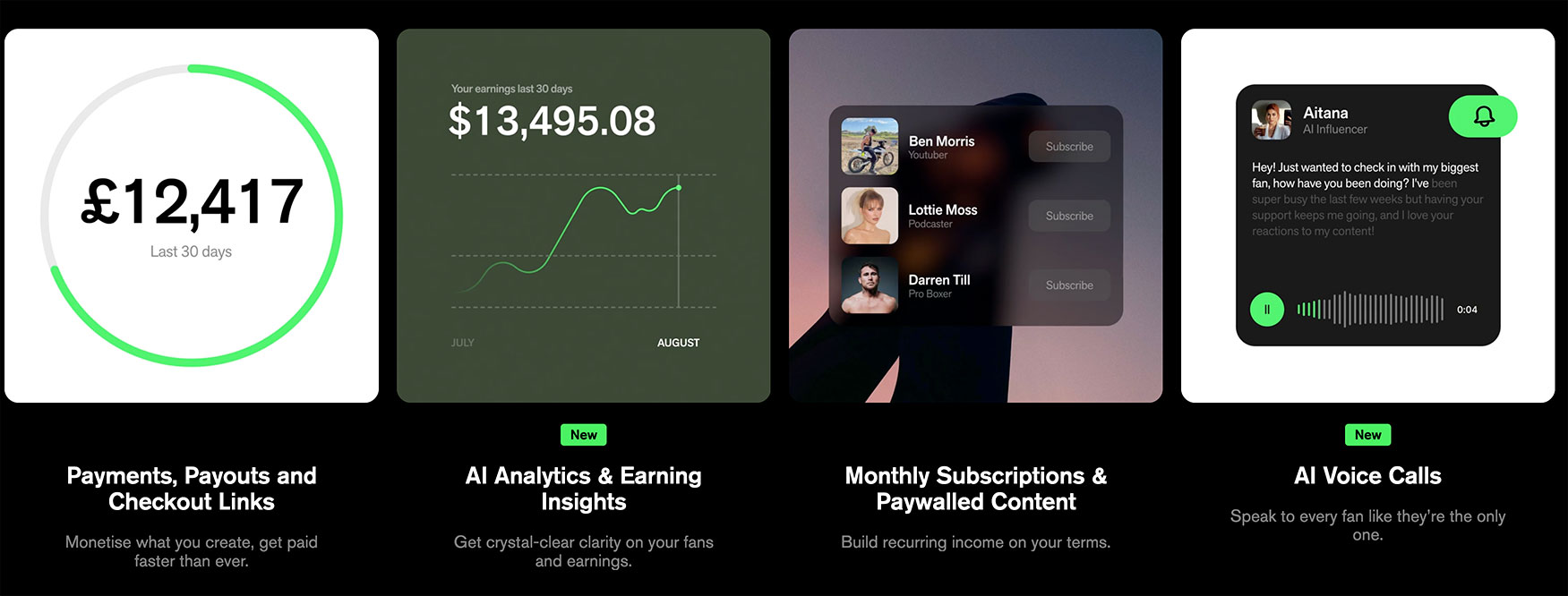
This appears in tools that quietly reshape the creator experience. Performance data is no longer something creators must manually interpret. Instead, AI-driven coaching surfaces insights in real time, guiding decisions around content timing, audience engagement, and revenue optimization.
Communication, once one of the most time-consuming aspects of fan relationships, becomes scalable through automated yet personalized messaging systems. Even content creation evolves, with AI-assisted workflows that allow creators to generate, refine, and publish without the same level of production strain.
Morris tells us the breakthrough lies in reducing the operational burden that has historically limited creator growth. “We needed to build a platform that would enable creators to make more money in less time,” he explains, pointing to the core issue Fanvue was designed to solve. That efficiency is not incremental. It is exponential.
AI, in this case, becomes a form of leverage. “It empowers creators to generate content at scale… whereby now it doesn’t take hours every day, but can take 10, 20, or 30 minutes,” he adds. The implication is profound.
The result is not just convenience, but transformation. As Morris sees it, this is not about replacing creativity, but protecting it. By reducing the mechanical burden of content production and fan management, creators are given back the one resource that has always been in shortest supply: time.
The Rise of AI Influencers and Digital Identity
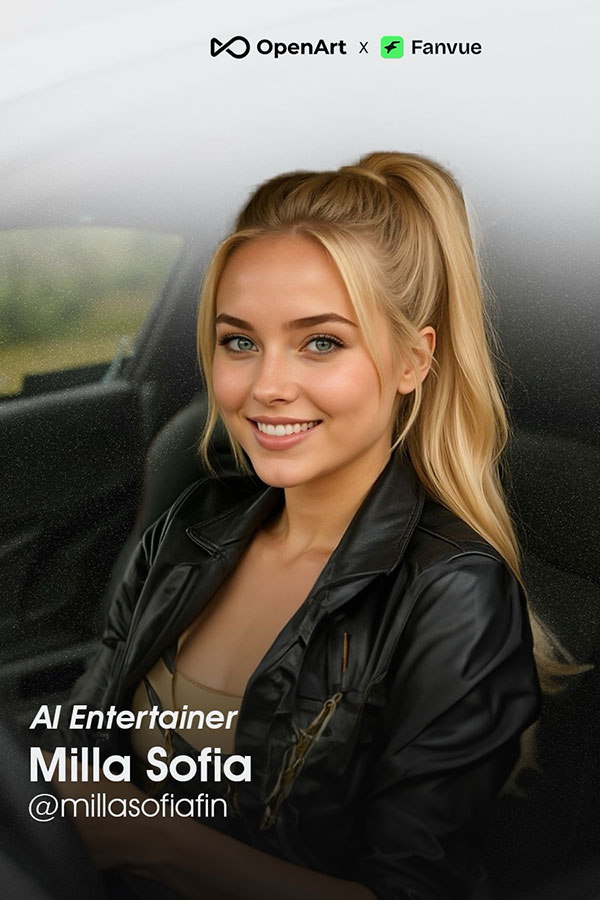
Fanvue’s visibility has been amplified by its role in the rise of AI influencers. The platform originated (perhaps unexpectedly) as a hub for synthetic creators, including hyper-realistic personas that challenge traditional definitions of authenticity.
Millennial Magazine explored this phenomenon in our 2024 feature on AI Instagram models dominating Fanvue, highlighting how these digital figures are reshaping influencer culture.
Yet Morris is careful to frame AI not as a replacement, but as an expansion.
“I think AI enables people who would have never created to otherwise participate,” he says.
Democratizing Creativity
Beyond efficiency, one of the most compelling implications of AI within Fanvue is its ability to expand who gets to join the creator economy. For years, influence has favored those comfortable on camera, equipped with production resources, or positioned within existing digital ecosystems. AI begins to shift that imbalance.
It opens the door for creators who may have previously felt excluded. Those who are camera-shy can now express ideas without the pressure of visibility. Individuals with disabilities are able to produce content in ways that were previously inaccessible. Emerging creators, often limited by budget or technical skill, can now gain access to tools that dramatically lower the barrier to entry.
Reflecting on his own early discomfort with being on camera, Morris sees AI as a way to unlock creative potential that might otherwise go unrealized. “There are so many creative people that don’t want to jump in front of a camera and speak to thousands of people online,” he explains, pointing to a vast, untapped layer of talent now entering the ecosystem.
This mirrors earlier platform shifts led by YouTube and TikTok, which democratized distribution. The difference now is scale. AI does not just make creation accessible. It makes it sustainable. It allows more people to create, more consistently, without the same physical or psychological constraints.
Still, the question lingers beneath the surface of this expansion. As AI continues to redefine authorship and identity, the industry must grapple with a new kind of tension: not just who gets to create, but how much of that creation remains human.
Transparency as the New Currency of Trust
In an ecosystem increasingly saturated with synthetic content, trust becomes a differentiator.
Morris is unequivocal: “Anything that isn’t transparent is a short-term play.”
Fanvue’s commitment to disclosure reflects a broader industry shift. Platforms are moving toward clearer labeling of AI-generated content, a trend that intersects with ongoing debates, especially at SXSW 2026, around authenticity on social media.
Whether it is AI-generated personas or enhanced creator interactions, transparency ensures that audience trust remains intact.

Beyond Adult Content: A Platform for All Creators
Fanvue is often categorized alongside adult-oriented platforms, but this framing is increasingly outdated.
“The biggest creators on our platform are not in that category,” Morris clarifies.
Instead, Fanvue is evolving into a multi-vertical creator economy platform, supporting fitness influencers offering personalized programs, educators monetizing niche expertise, entertainers producing episodic content, and influencers building subscription-based communities.
This shift reflects a broader move toward owned income streams.
Internal Ecosystem Opportunities
Within Millennial Magazine’s editorial ecosystem, Fanvue’s evolution connects naturally to some of the most defining conversations we’ve had shaping the modern creator economy.
From influencer monetization strategies to subscription-based content trends, digital entrepreneurship, and the rise of creator-led business models, the platform sits at the intersection of multiple high-growth verticals. What emerges is not another tool, but a foundational layer for building and sustaining influence.
Morris describes this positioning as intentional. Rather than narrowing the platform to a single category or content type, Fanvue is designed to accommodate a wide spectrum of creator ambitions. “We’re extremely excited about enabling monetization for a broad range of people that have influence,” he explains, emphasizing the platform’s commitment to flexibility over specialization.
This expansive approach allows creators to construct entirely personalized ecosystems within their own audiences, as seen with the recent inclusion of influencers such as women’s footballer, Alisha Lehman and music artist, Chesca.
As Morris sees it, the real opportunity lies in empowering individuals to turn niche expertise into scalable businesses. “You could have 100 subscribers paying $10 a month and you’re already making $1,000,” he notes, pointing to a model where sustainability no longer depends on mass virality.
These intersections reinforce Fanvue’s positioning as more than a niche platform. It is becoming a hub for the next generation of digital entrepreneurs.
The Economics of Direct-to-Fan Monetization
At its core, Fanvue is reshaping the economics of digital influence by challenging the long-standing dominance of ad-based revenue models. Traditional platforms rely on CPM structures, where earnings are tied to volume, often requiring creators to chase views at scale to generate meaningful income. Fanvue disrupts that model by shifting the focus from reach to relationship.
“With a subscription, one fan can equal thousands of views,” Morris explains, distilling opportunity into a single, powerful insight. The implication is a fundamental reordering of value. Instead of prioritizing mass exposure, creators can focus on cultivating smaller, highly engaged communities that deliver consistent and predictable revenue.
This shift has far-reaching consequences. It allows niche creators to achieve financial viability without needing viral reach. It introduces a level of income stability that has historically been absent. And perhaps most importantly, it gives creators greater control over how they structure their businesses.
Fanvue supports this flexibility through a range of monetization options, from recurring subscriptions to one-time purchases and tiered access models. But the real innovation lies in how these tools can be combined. Creators are no longer confined to a single revenue stream. They can design layered offerings that reflect the depth and diversity of their audience relationships.
For Morris, this is where the model becomes transformative. It is not just about earning more, but about building something sustainable.
Fanvue’s model is equally pragmatic. The platform takes a 15 percent commission in a creator’s first 30 days, rising to 20 percent thereafter. Aligning with industry standards, this structure is comparable to OnlyFans’ flat 20 percent rate, but adds exclusive access to customizable AI tools and backend analytics.
Scaling Intimacy in the Age of AI
Perhaps the most radical aspect of Fanvue lies in its approach to fan engagement.
Traditionally, intimacy does not scale. A creator can only interact with so many fans.
But AI changes that.
Morris describes the future of fan engagement as deeply personalized. “[Fanvue] allows creators to connect with their audiences at a better scale… whereby now it doesn’t take hours every day,” he explains, pointing to a shift where interaction is no longer limited by capacity, but expanded through intelligent systems.
AI-driven tools on the platform make it possible for creators to deliver tailored voice notes, customized content, and individualized responses that feel direct, even when they are generated at scale. As Morris puts it, the long-term vision edges toward a reality where even the most high-profile figures can maintain meaningful engagement with thousands, if not millions, of fans simultaneously.
“Imagine you can enable someone like Drake to FaceTime hundreds of thousands of fans… whereby every single stream is hyper-personalized and unique,” Morris explains, illustrating just how far this model could extend. While the concept may sound futuristic, it reflects a broader shift already underway across the creator economy.
Strategic Growth and Cultural Relevance
View this post on Instagram
Fanvue’s rapid ascent– now housing more than 200k creators and generating more than $500M in payouts– is supported by both capital and cultural positioning.
Following a $22 million Series A raise, the company is investing in advanced AI development, global talent acquisition, and U.S. market expansion.
Recent partnerships with high-profile figures like Cardi B underscore its ability to operate at mainstream scale while maintaining a creator-first ethos. Cardi B recently used the platform to host a ticket giveaway for her upcoming tour. “We’ve never seen anything like it… the engagement was pretty insane to see,” Morris enthuses over the use-case.
The Hybrid Future of Creators
Looking ahead, Morris predicts a hybrid model where creators blend human and AI-generated content seamlessly.
“I think the majority of creators will be hybrid,” he says. This evolution will be driven by advancements in AI video generation, increased demand for personalized content, and the need for sustainable production workflows.
Fanvue’s roadmap reflects this future, with plans for an open app ecosystem, creator-built tools and integrations, and deeper AI personalization capabilities.
This positions the platform as a customizable ecosystem for digital entrepreneurship.
Why Fanvue Matters Now
As a second-click platform, Fanvue captures value after discovery, turning passive audiences into paying communities. By addressing the inefficiencies that creators have long accepted as inevitable, the platform offers a blueprint for a more sustainable and profitable future.
For a millennial audience navigating side hustles, personal brands, and evolving career paths, this model is not just relevant. It is essential.
As the boundaries between human creativity and machine assistance continue to blur, Joel Morris stands at the forefront of a transformation that extends far beyond one platform.
Fanvue is not competing for attention. It is redefining where that attention becomes valuable.
By actively shaping the next chapter of direct-to-fan models, they are setting a new precedent where influence is owned, monetization is direct, and creativity is no longer limited by time or scale.
FAQ
Who is the founder of Fanvue?
Joel Morris is the founder of Fanvue and a former YouTuber who built a multi-million subscriber audience before launching a creator monetization platform.
What is Fanvue used for?
Fanvue is a subscription-based platform that allows creators to monetize content through direct fan engagement, AI tools, and personalized experiences.
Is Fanvue better than OnlyFans?
Fanvue differentiates itself through AI-powered tools, broader creator categories, and a focus on scalable monetization beyond adult content.
How do creators make money on Fanvue?
Creators earn through subscriptions, one-time payments, and premium content offerings tailored to their audience.
Are AI influencers profitable?
Yes, AI influencers can be highly profitable due to lower production costs and scalable content creation, especially on platforms like Fanvue.
Can beginners use Fanvue?
Yes. Fanvue’s model allows even small creators with niche audiences to generate income without needing massive followings.
What is the future of Fanvue?
Fanvue is focused on expanding AI capabilities, building a creator app ecosystem, and scaling globally, particularly in the U.S. market.
Continue Exploring the Creator Economy
Joel Morris is rebuilding creator monetization on AI infrastructure, one corner of a much larger shift. Keep reading across the series: why the creator economy is splintering and thriving at once, how the major creator platforms compare, the AI music reality surfacing at SXSW 2026, why the smartest creators stopped renting their faces, and how creator pay and brand deals are being rebuilt for 2026. It all ladders up to the 2026 playbook on turning audience into asset.